Getting Schooled: Review

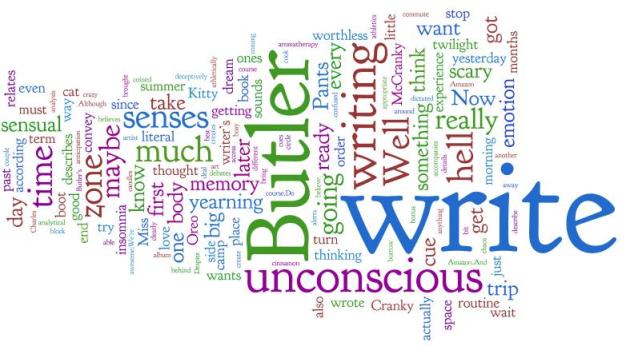
So today I thought we’d review what we’ve learned so far thanks to Robert Olen Butler. But instead of actually writing something, I thought I’d let the Internet do it for me.

Just think of how close we are to the day where we won’t have to write our own blog posts!

Let’s review:

words

Summary brought to you by Wordle.

Getting Schooled: The (twilight) zone

Now that we’ve left boot camp and hell (bonus side trip!), we get to enter the zone. If you’re familiar with the term re: athletics, Butler uses it much the same way. It’s muscle memory, only for writing, it’s dream space or sense memory. You perform (or write) without thinking. It’s all from the unconscious.

So, cue the music: Y’all ready for dis?

I thought so.

But getting into the zone is difficult. We don’t want to go there in the first place (hell, remember?), so NOT going there is far more tempting than actually going there. Until we actually get there, that is. Because when you’re writing in the zone, it’s great. You’re on the literary equivalent to a runner’s high.

So, getting there? Well, here’s Butler on that:

You may not be ready to write yet, but when you’re in a project you must write every day. You cannot write just on weekends. You cannot write this week and not next; you can’t wait for the summer to write. You can’t skip the summer and wait till the fall. You have to write every day. You cannot do it any other way. Have I said this strongly enough?

So … is he saying we should write every day?

He suggests writing in the morning (going from one dream space to another), but most importantly, using something–a cue, a routine, anything that says: I’m writing now.

This alerts your imagination that it’s time to get busy. So, light your aromatherapy candles, cue up your Yanni album to track three, and set your word processor’s font to GirlyGirl.

Whatever works. Although Butler isn’t talking about pampering so much as routine. He relates how he wrote four of his novels on his train commute from Long Island to Manhattan and had a terrible time when he moved to Lake Charles, LA during the middle of his fifth novel.

Butler also talks about what happens when you don’t write. Unlike a lot of writing gurus, he does believe writer’s block can happen. Again, unconscious = scary place = no writing. You know something is off, you try to write, but you’re thinking too much and nothing’s there.

He relates it to having insomnia. I’ve coined the term “writer’s insomnia” and I think it perfectly describes the state. I know I should write; I really want to write. I try to write.

I got nothing.

It can really turn you into a Cranky McCranky Pants. (Not to be confused with Hottie McHottie Pants. Two totally different things.)

Butler describes the self-loathing that accompanies this: you’re both a worthless human being and a worthless writer.

If this is the only message I take away from this course, it will have been worth it.

Because I’ve been Cranky McCranky Pants for the past couple of months. It sounds crazy to have a book sale, with that book coming out in eight months, and not be able to write. But there you have it. I’ll spare you my self-loathing.

The remedy is deceptively simple. You write. Sure, it’s scary, and there’s all those side trips Butler wants you to take. But in the end, you-to borrow an overused but athletically appropriate phrase-just do it.

Getting Schooled: Making sense(s)

Despite what I wrote yesterday, Butler really wants to be your friend. He does! He loves you!

Butler’s premise is this: to create art, we must write from the unconscious. We cannot think–as in analytical thought. We have to turn off that self-conscious inner voice that’s going all the time.

Do you narrate your own life? Well, stop it.

It sounds easy, tapping into the unconscious, but according to Butler, not so much. He says:

If the artist sees the chaos of experience and feels order behind it and creates objects to express that order, surely that is reassuring, right? Well, at some point, maybe. But what do you have to do first? And why is it so hard? This is why-and this is why virtually all inexperienced writers end up in their heads instead of the unconscious: because the unconscious is scary as hell. It is hell for many of us.

So, the first stop on our Butler tour was boot camp. Now we’re in hell. Nice.

But why is writing from the unconscious so important? Well, according to Butler, you access your sensual memories rather than your literal ones that way.

This is why when you write something from literal memory no one believes it, even though you protest, “But it really happened!”

Write a big honking lie, but write from the unconscious, from emotion and the senses, and everyone thinks it’s true to life.

Butler’s deal with the senses: Emotions are experienced in the senses and therefore are best expressed in fiction through the senses. He’s got five for you:

  • Sensual reaction: inside our body, such as body temperature, heartbeat, throwing up a little in your mouth, and so on.
  • Sensual response: what we send outside our body: posture, gestures, facial tics. Any YouTube of the presidential debates would make an excellent primer for this.
  • Experiences of emotion: flashes from the past, not so much analysis as impressions, waking dreams.
  • Flashes of the future: essentially anticipation, yearning (more on yearning later; Butler is big on yearning).
  • Sensual selectivity: we have to select which senses to convey in a story, since at any one time, we experience thousands of sensual cues. In other words, we don’t want the kitchen sink of details flooding our stories. How do you pick which ones to convey? Well, by emotion, of course.

Do you feel like we’ve just traveled around in a big circle? I think maybe yes. But that’s okay, it’s gets us ready for our trip into the (twilight) zone. More on that later.

Getting schooled: Robert Olen Butler’s boot camp

So because insanity is my middle name (well, not really …) I’m taking a writing class. Yes, I know what you’re thinking: Have you ever not taken a writing class?

Sadly, the truth is, I’m either taking a writing class or thinking about taking a writing class.

This particular class is based on Robert Olen Butler’s From Where You Dream: The Process of Writing Fiction. Not only does the class come with reading and writing assignments, but a quiz! Each week! Dude. I had no idea.

So, I’m going to blog a bit about it here. You’re riveted, I know.

The first chapter is Boot Camp and it starts with this quote from Akira Kurosawa:

To be an artist means never to avert your eyes.

Quick! Look over there!

Sorry, couldn’t resist. Why is this chapter called Boot Camp? I think it’s for the following:

…. the great likelihood is that all of the fiction you’ve written is mortally flawed in terms of the essentials of process.

We’re not even off the first page yet.

What I have to say to you will indict virtually everything you’ve written.

Page two.

Are we having fun yet? Boot camp? Oh, yes. We’ve just tripped down the bus steps and met our drill sergeant. Next up, the YouTube of me deleting all the writing on my hard drive.

Actually, what Butler is driving at is the idea that we don’t write with our head. The story should come not from the mind, but from where you dream, from your unconscious.

This is great news for those of us who never felt quite smart enough to write in the first place.

Anyway, we’re just getting started with Mr. Butler. Next up: I over analyze stream-of-consciousness.