Of writing tears and garden friends

So, I’ve been on a patented Jo March writing tear (I really need to get a writing cap like Jo has). This is on the new book (series, duology—your guess is as good as mine) I mentioned a while back.

It is coming along, which is all I’m going to say at this point in the project.

Mattie and Oscar helping in the garden.

In other (wonderful) news: Spring. Has. Sprung.

We are planting, haphazardly, it’s true. Despite taking the master gardening course, I will most likely remain a haphazard gardener.

So, yes, that’s an entire flat of zinnias you see. No, I have no idea where I’m going to plant an entire flat of zinnias. It’s true our eyes are much bigger than our garden space.

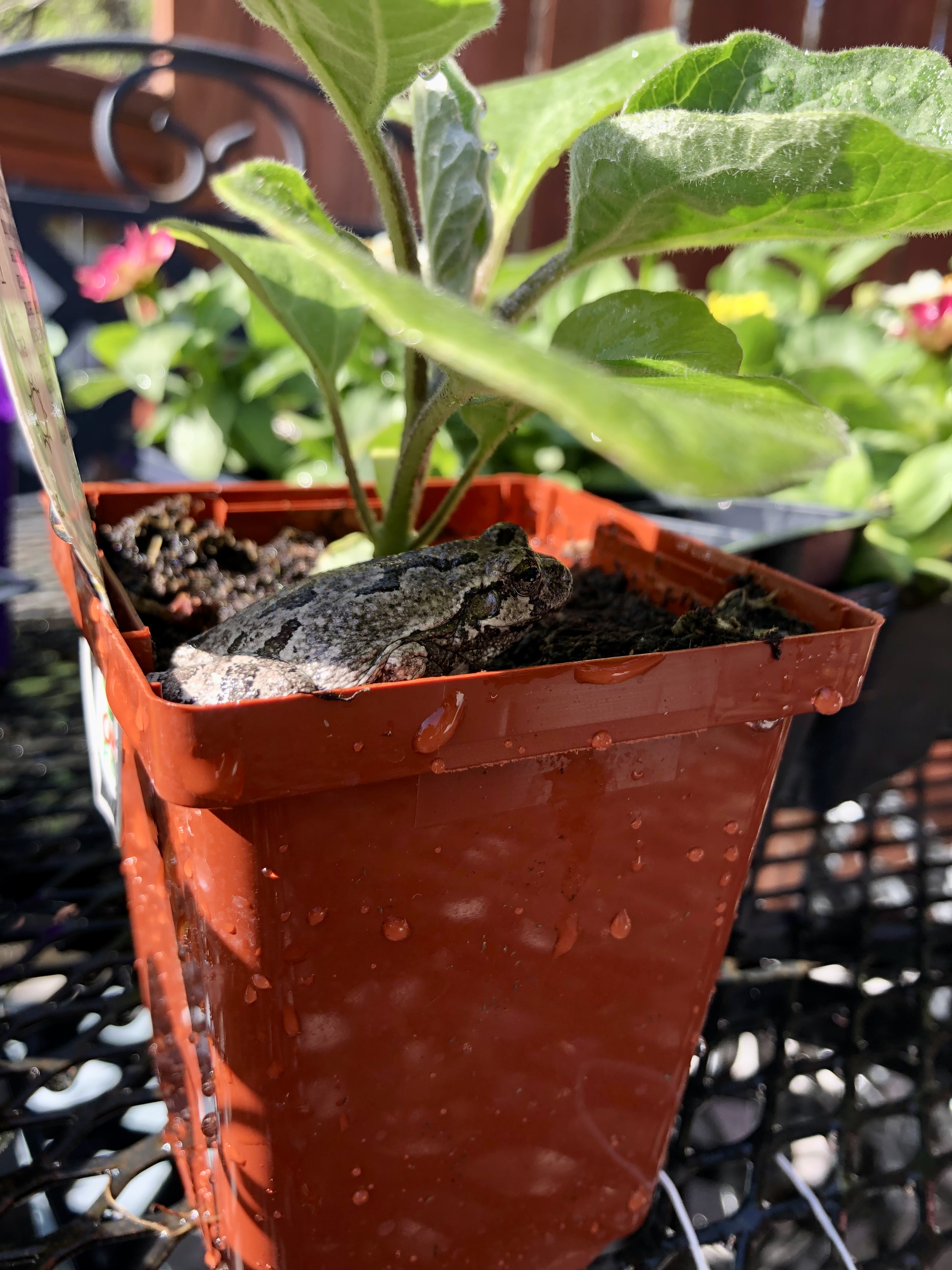
Toad resting beneath an eggplant.
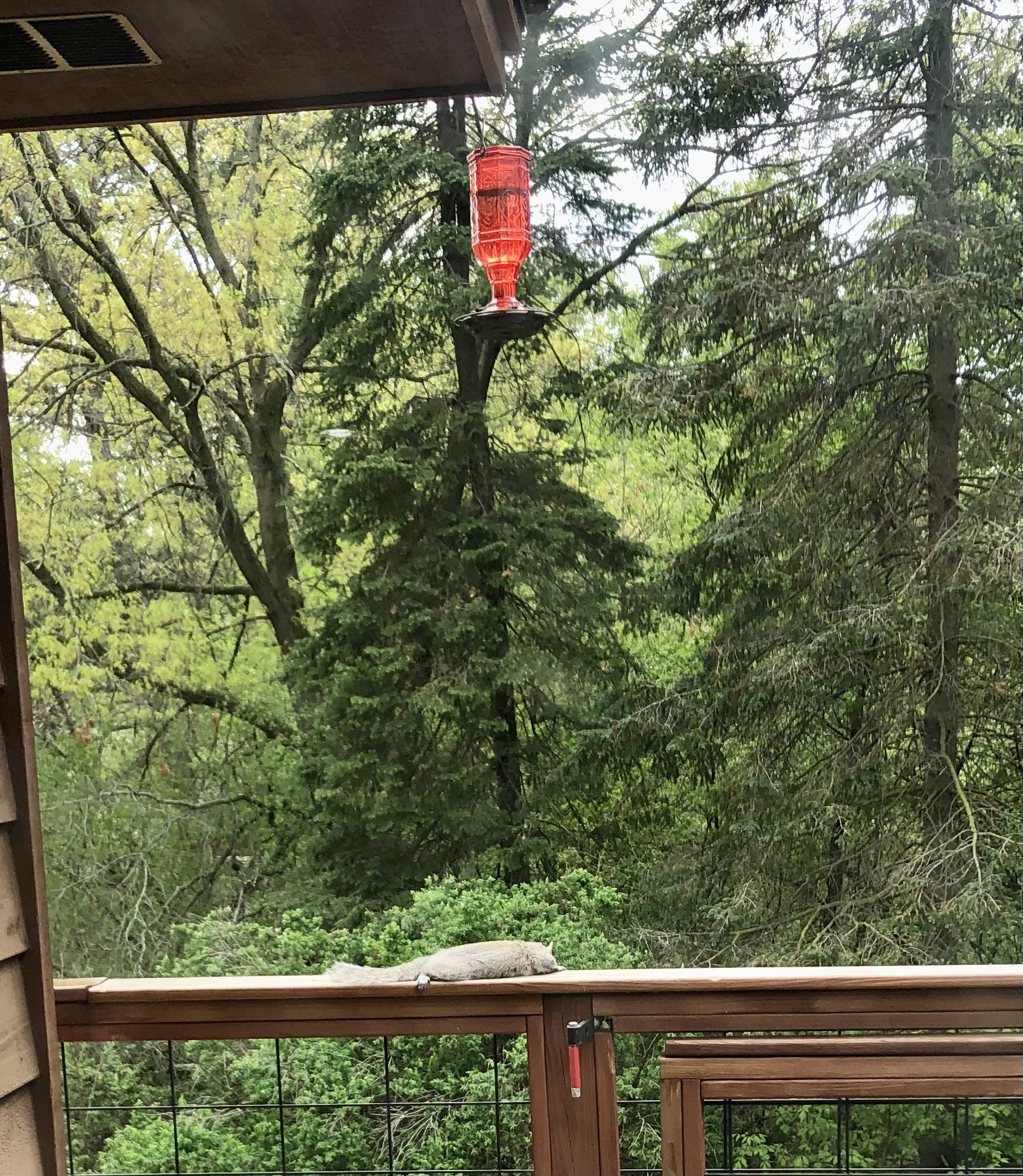
Squirrel despondent since I replaced the birdseed feeder with the hummingbird one.

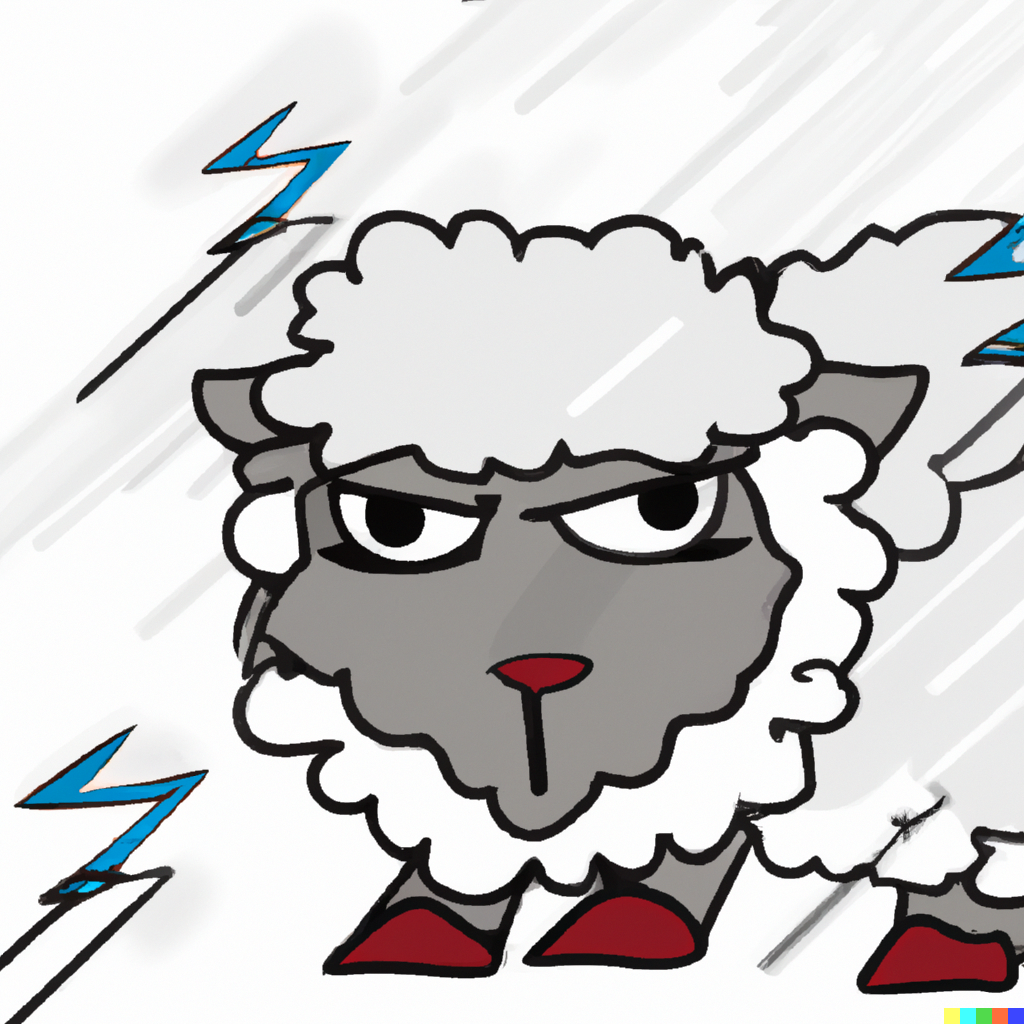
March: out like a lamb, an angry, angry lamb

The last day of March went something like this:

Lightning, thunder, rain, sleet, hail, snow, BLIZZARD.

Yes, an angry, angry lamb.

Angry lamb in blizzard generated from DALL·E

Then, yesterday, we had this:

Those lumps and stakes on the right? Those would be my raised beds, assuming they weren’t under another foot of snow. So, April Fools on us.

In other news, I might be writing a bit. Don’t want to say too much about it. Honestly, I’m not exactly sure what it is quite yet. One big book? A duology? A series? Your guess is as good as mine. (No, really. At this point, it is.)

But I suppose the snow is an excellent excuse to stay inside and read and write, no?

This winter: so very taxing

So yes, I fell off the blogging bandwagon.

More accurately, I fell off the blogging bandwagon, hit the slush-covered gravel road, rolled into a ditch, and then low-crawled until I found an abandoned fox den, where I proceeded to curl up and hibernate.

Just kidding. I didn’t actually hibernate.

Because neither does my new friend.

This little one has been hanging around our back deck, probably because that’s where the birdfeeders are.

He/she is highly skilled at finding everything the chickadees and squirrels leave behind.

And since opossums also eat ticks, I’m hoping this one sticks around for summer.

In other news, I have a drabble (a story that’s exactly 100 words, minus the title) in Issue 27 of Scribes*MICRO*Fiction. And They All Lived is not a fairy tale, but I think (hope) it’s a complete story.

Thoughts on Bloganuary 2023 (also, work is a bear)

I’m so glad I did the challenge. So, so glad. Granted, I didn’t do it exactly as prescribed. But going into it, I knew I wouldn’t be able to.

There’s a difference between writing in a journal and shaping your thoughts so others can understand them. Obviously, you don’t have to share everything. But working through the prompts brought clarity to my thinking. Far more than I expected.

I want to keep blogging in this manner. It’s fun. I’m enjoying it.

However, a blog post a day—or even a prompt a day—is not sustainable. I’ve had to set aside other writing, and other things, to do this challenge. And it’s not so much the writing part; it is the shaping, the proofing, and the posting that takes time.

Also, a post a day leaves me little time to comment on other blogs. Part of the reason I did the challenge was to get back into both blogging and connecting with other bloggers. I want to make a concerted effort to reach out and comment more often.

The other reason for my lack of time is that work is a bear.

Just for fun, I submitted work is a bear as a prompt for DALL·E.

This accurately illustrates how I feel at the end of the day. Really, our AI overlords know far, far too much.

I’m trying to adjust and create a schedule that includes blogging, writing, and other things. It may take a few tries. In fact, I know it will. Still, I plan to be here on the blog more often, and I’m looking forward to visiting other blogs regularly.

The story of our lives

Bloganuary: What would you title the chapters of your autobiography?

I’m not sure I would write my autobiography. (Isn’t that what a blog is for?) But if I did write one, I do know this about the chapter titles:

Puns would be involved.

I love puns and plays on words. If you’ve read any of my Coffee and Ghosts episodes, you already know that. Of course, it often takes me a long, long time to think them up. This is the reason Coffee and Ghosts is called Coffee and Ghosts.

Initially, this was the working title for the series. But when it came time to publish, I kept spinning my wheels for a better title. At last, I kept the working one because, if nothing else, it’s accurate.

Silliness aside, I am noodling a memoir. I almost hesitate to mention it because this might not come to pass. Every time I inch closer, I take a step back. This might be because I’m not ready to write it. It might be because I know it’s going to hurt.

But here’s the thing. I want to explain how caring for my mom during the last six months of her life was like being at war. It was like seeing the elephant all over again. I want to explain—if only to myself—why these two things are linked. Because somehow, they are linked in my mind and my heart. Maybe, if I can explain the why and the how behind that, I can help someone else.

But for now? I’ll simply ponder it.

The stakes are a lie

Bloganuary: What’s a lie you tell yourself?

Well, this one’s a bit salty.

For me, it’s this idea that sometime in the misty future, I’ll be able to earn a living with my fiction writing.

This notion is so ingrained I’m not sure I can completely rid myself of it. But I’m trying to. Not because I dislike making money from my writing. I enjoy that.

But it was never my original motivation for writing fiction in the first place. I’ve been thinking a lot about this over the past several months. Interestingly, writing these prompts every morning has helped clarify some of the thinking, even those prompts that don’t relate to success or goals.

Or maybe especially those. It reminded me that I love to write. That my first motivation for doing so was to have stories I couldn’t find anywhere else.

When I started writing, I recognized the gap immediately. What I was writing did not match what I was reading in published novels. This frustrated me.

So I used publication as a way to gauge my progress. It was a great way to work with editors and learn.

At some point, instead of being a means to an end, publication became the end. Back in the days when traditional publishing ruled, the author with the most contracts (or awards or bestseller lists) won.

And I was—frankly—miserable. I maybe didn’t show it, but deep down, I was.

Then indie publishing came along. For a good couple of years, I had so much fun—again, learning and making progress. I love creating books, from the wispy first ideas to the finished project.

But then sales and money became the markers of success, to the point where it’s binary. If you aren’t earning “good money” (however you define that) with your writing, you should quit. Or at least, this is what it feels like. The notion permeates so many conversations about writing and publishing. It’s the water we swim in. (Which is why I’ve opted out of most of those conversations.)

For me, at least, it’s not a binary choice. Perhaps this is unique to American culture. But holy cats! We don’t need to monetize every last thing we do. Writing has worth. Whether you earn six figures from it or you simply blog for the joy of it.

I’m trying to unlearn this lie. And while I like it when people buy my books, it’s not why I write them.

So I’m searching for a new way forward. Perhaps, if I reach into the past and take the hand of the woman I once was, we can find our way into the future.

Girl Detective to the rescue

Bloganuary: What was your dream job as a child?

It was my heart’s desire to be a girl detective.

When I wasn’t reading the Betsy-Tacy books, I was probably reading a mystery. I even wandered into the adult stacks at the library and pulled Agatha Christies off the shelf when I was still fairly young.

But the mysteries I loved most were the Trixie Belden ones.

Yes, I read Nancy Drew. But Nancy was so … so … perfect. Trixie? Not so much. Trixie got into trouble, sometimes said the wrong things. To my young mind, the mysteries felt like they really could happen, and Trixie (and her club) really could solve them.

Which meant that maybe there were mysteries out there for me to solve.

I was certain there had to be. For instance, at least one mystery must have been going on in the dilapidated old workshop at the end of a dirt road not far from my house. It stood next to a copse of manicured pines—a strange sight for this part of our town. We had the slough and hills of deciduous trees, but these pines were clearly cultivated, but for what purpose wasn’t clear.

Truly a mystery. And they made excellent cover for spying on the neighborhood, particularly that old workshop. I only gathered the courage to approach the main door once. Then I thought I saw a face in the second-floor window (probably the old man who worked there and whom I was no doubt annoying). I’m not proud to say it. But.

I ran.

So much for my career as a girl detective.

On a positive note, I did not get into trouble for trying to solve mysteries that didn’t exist.

Sometime later, I realized that you could experience mysteries and adventures by not only daydreaming them but writing them down.

What a revelation!

I’m not sure where this early love of mysteries came from. Even now, I love reading (or writing) stories with secrets and mysteries. And I think I may need to go find one. The temperature is below zero, with no signs of warming up, and I could use a good mystery or secret to help me brave the day.

Down in the valley

Bloganuary: Who is your favorite author and why?

Like Anno, what I’m reading and why depends so much on my mood that I wasn’t sure I could pick a single favorite author.

But actually, I do have one.

It’s always bothered me that Maud Hart Lovelace never received the same attention as that other author who spent time in Minnesota.

The Betsy-Tacy books were my constant companions when I was growing up. How many times have I read the series? No idea. And I can’t remember when I “graduated” from the elementary school stories and started reading the high school (and beyond) ones. Relatively young, I think—I remember being dazzled.

I grew up in Maud’s Deep Valley (AKA Mankato). My house was in the area known as Little Syria in Maud’s day. And if I trudged up a sizable hill, I ended up in Betsy’s old neighborhood.

In fact, when I was in junior high, I had a paper route where I delivered papers to Betsy, Tacy, and Tib’s old homes. If you’re of an age, you’ll remember the weekly shoppers that landed on your doorstep—advertising and classifieds held together with a smattering of human interest articles. The route was only once a week (rain, shine, or snow). And I didn’t have to collect any money. Again, if you’re of an age, you’ll remember that part of newspaper delivery.

And it was in junior high that I needed Betsy the most. The progressive school I attended—which was run by the university—closed down when I was in sixth grade. The only other option was the public school system.

So on the first day of junior high, I had no friends. Worse, on the first day of junior high, I already had a reputation—as did everyone who attended the progressive school. Fill in the blank with every derogatory term for mentally deficient, and you’ll have what I was called daily.

By eighth grade, I had a friend group. By eighth grade, I’d spent every quarter on the honor roll, so I was deemed a bookworm, a brain, a nerd.

But in seventh grade, when the days were dark, and I was sore from lugging papers around the neighborhood, I’d pull the Betsy-Tacy high school books off the shelf. I’d escape into her world of picnics and dances, the crowd and crushes. My first inklings that I, too, could be a writer began with watching Betsy write.

There’s much I owe both Betsy and Maud. And that is why Maud Hart Lovelace is my favorite author.

Published: Field Manual for Waiting

Yesterday, I received my author copies for Issue 29 of the Blue Earth Review.

Isn’t it gorgeous?

It’s been my aim, for a while, to get a piece accepted in this publication. This might seem like a random goal, but I had my reasons. A handful, actually.

The Blue Earth Review is Minnesota State University, Mankato’s literary magazine. I grew up in Mankato, my father taught at the university for 28 years, and my daughter recently received her Associate of Arts degree from there.

It is a literary magazine, however. Normally my writing does not skew literary. I’ve only submitted there once before, with a piece I thought might fit. (Clearly, it didn’t.)

This time, I submitted a piece I wrote during a class I took this past July on writing about grief.

“Field Manual for Waiting” is written in the second person, present tense, and ties together two events that occurred 30 years apart. (And yes, where else am I going to send something like that but a literary journal?)

I’m pleased the piece was a runner-up in the creative nonfiction category of their Dog Daze contest. I’m really pleased with the production values. Again, this little journal is gorgeous, and I’m glad “Field Manual for Waiting” found a home there.

The fine art of public speaking

Bloganuary: What fear have you conquered?

When I was sixteen, I decided—somewhat out of the blue—that I couldn’t go through life being petrified of public speaking.

Because I was petrified. And I knew that other people would expect me to talk, especially as an adult. Because that’s what adults did. They talked.

So I joined our high school speech team.

Nearly every weekend during the season, I’d hop on a school bus and ride with my teammates to wherever that week’s tournament was. I’d read my piece three times. At the end of the day, I’d dissolve into a puddle.

At first, I was terrible. Really, really terrible. I’d rank the lowest in each of my rounds (a 5 on a scale of 1 – 5). I was okay with that because I wasn’t doing this to win a prize.

But a funny thing started to happen. By the season’s end, I was pulling in solid 3s each round, with a scattering of 4s or even a surprise 2.

The following year? I started at the 3 and 4 ranks and inched my way up. I earned an honorable mention at one of our big tournaments hosted by our rival high school and actually placed third in another.

I didn’t go to the state tournament, but then I didn’t want to. I’d accomplished what I set out to do, and I was no longer the participant everyone felt sorry for in each of my rounds.

And many years later, I wrote a novel based on these experiences.

Make no mistake: I still don’t like public speaking. You won’t see me joining Toastmasters any time soon. But I look back on that sixteen-year-old and marvel at how she could’ve been so prescient … and brave.