Ours is:

Wishing everyone a most bejeweled and bedazzled Thanksgiving.

Ours is:
Wishing everyone a most bejeweled and bedazzled Thanksgiving.
So, I’m off work this week, transfixed by how quiet it is when the kids are not home. Things I’m doing:
Stay tuned for exciting page count updates. Sure to be the highlight of your Thanksgiving weekend.
So today Bob outfitted the kids for their ongoing sibling battle:
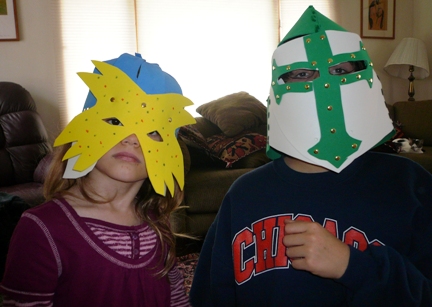
The kids, ready to continue their war. Oreo, enthralled, watches in the background.
So after school, Andrew sometimes uses my computer. On the front page of Amazon.com, I found these in the recently viewed items:
I have to mention that the Mojo Rails Complete Skate Park is on sale, for ~ $4,000. A steal. Plus, it qualifies for Amazon Prime. Hey, free shipping! Seriously, they’re practically paying you to get one.
I wonder if this has something to do with the skateboard tournament he said he wanted to host a few weeks back. Being boring and practical, I mentioned things like insurance, liability, massive lawsuits, and so on. He was unmoved.
The real question is why hasn’t he approached Miss B. She would gladly construct a skate park for him out of paper.
That would work, wouldn’t it?
Yet another fascinating way to waste time since I discovered Wordle. I give you
It analyzes your blog (or really, anyone’s blog) and suggests what personality type you are, or at least what you’re writing personality type is when you blog. How’s that for specific?
Writing Wrongs happens to be The Mechanics:
The independent and problem-solving type. They are especially attuned to the demands of the moment are masters of responding to challenges that arise spontaneously. They generally prefer to think things out for themselves and often avoid inter-personal conflicts.
The Mechanics enjoy working together with other independent and highly skilled people and often seek fun and action both in their work and personal life. They enjoy adventure and risk such as in driving race cars or working as policemen and firefighters.
That’s it. I’m giving up writing and racing cars for a living. Or not. Still, this might explain the whole jumping out of airplanes thing.
So, last night I’m in one room, the kids in another. There might have been (nerf) football throwing going on. But it was getting close to bedtime, so I say:
Me: No more rowdy. It’s time to get ready for bed. Play a quiet game.
Kids: Okay!
Andrew (after a barely imperceptible pause): Kyra, throw this at me as hard as you can.
Yeah. Some days it’s like talking to the walls.
Despite all his talk about writing from the unconscious, Butler believes a writer should prepare before sitting down to write a novel.
So, does he want you to outline?
Nooooooo.
Brainstorm, do character sheets?
Nooooooo.
Plot boards, Excel spreadsheets, synopses?
Nooooooo.
He wants you to dreamstorm your novel. Yes. You’ve heard it here first. (Well, unless you’ve read Butler’s book, in which case, you heard it there first.)
It goes something like this:
Butler believes in the natural sequence. (I don’t know if this is like natural selection or not.)
Actually, what he means is the scenes will eventually fall into an order that works for the story. You start with the best point of attack, Then select a few more follow-up scenes to write. after you write those scenes, you look at the remaining ones. You may need to rearrange or dreamstorm new scenes based on what you’ve written.
He doesn’t like the idea of writing out of order. If you start writing a scene without any previous context, he believes you’ll lose the unconscious aspect of it. You end up creating ideas as to why the scene is happening rather than dreamstorming them.
At some point you type: The End.
In all seriousness, I am all over the index card idea. You can do anything with index cards. Miss B can create a whole cityscape with inhabitants and pets with index cards. The very least I can do is write a novel.
Now here’s a chapter I think we can all get behind. Butler calls it cinema of the mind. He’s not talking adaptations here, but rather film techniques writers can use. These are:
Butler considers the montage the most crucial element (that’s why it gets its own paragraph). This is where you put two things next to each other, causing a third to emerge.
For instance, we see pie tin with a bit of lone crust, a smear of chocolate filling, a bit of whipped cream. On the floor, two children (perhaps a big brother and his little sister), mouths rimmed with chocolate, whipped cream on noses and cheeks, the two snoozing lightly.
Yeah, we pretty much know what went on.
And that’s pretty much it. I know. Butler, this easy? Okay, so in the text, he goes into detailed (but helpful) examples from Hemingway and Dickens. But the advice is to write the movie in your mind.
Ha. You thought I forgot. But, I. Did. Not. Butler is back and he’s feisty as ever. Today’s topic is yearning. Or, in Butler’s words:
I would say that of the three fundamentals of fiction, there are two that aspiring writers never miss: first, that fiction is about human beings; second, that it’s about human emotion. Even when fiction writers are writing from their heads, abstracting and analyzing, they’re mostly analyzing emotions; so even if they’re not getting at the essence of emotion, they’re trying to.
But the third element, which is missing from virtually every student manuscript I’ve seen, has to do with the phenomenon of desire.
By which he doesn’t mean romantic desire (although I suppose it could).
Yearning is always part of the fictional character. In fact, one way to understand plot is that it represents the dynamics of desire.
He goes on to state that you can have a story rich in character, conflict, problems, attitude and so on, and totally miss the desire boat. And if that ship sails without you, you pretty much don’t have a story.
This is also the chapter with what I call the Great Genre Dis. Butler draws a firm line between writing that is art and … all the rest, what he calls “entertainment writing.”
Nice.
His main argument is essentially that this type of writing uses generalizations and abstractions and that what readers do is fill in the blanks left by those abstractions.
I’m neither here nor there with this argument, although I know it upsets some writers greatly. There’s some great genre fiction out there and some pretty crappy literary fiction. I also find some “entertainment fiction” far from entertaining and some literary fiction utterly absorbing.
I don’t know art, but I know what I like? What else can you say?
Still, Butler does give genre writers their props, since they almost always “get” the idea that their character yearns for something–to solve the mystery, save the world, get the girl. (Dude, that sounds like a great story. I’m so writing that.)
So, genre wars aside, yearning is a concept that you can apply to any type of writing. I decree it so.
Speaking of yearning, I’m sure you’re dying to know how I’ve done on my quizzes so far:
Quiz 1: 13/15 for a B
Quiz 2: 8/8 for an A
I’d write something today, but …
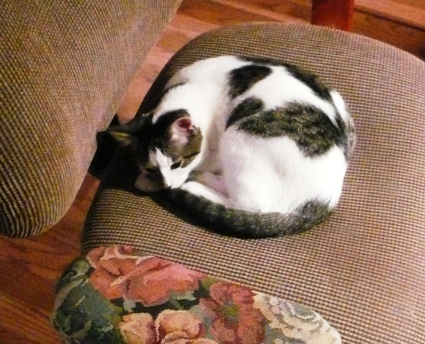
Someone has stolen my chair.
So, yesterday, I took a trip to Staples. And walked out with a box containing ten reams of paper. That’s 5,000 sheets of paper.
That should keep me and Miss B supplied–at least for a little while. I think that’s enough for her to create an entire paper world, complete with its own paper ecosystem.
I also wandered into the clearance section and wandered back out with white boards in silly shapes and singing pens–all fifty cents each. Uh, these would be for the kids, not me.
In the end, I walked out without causing too much damage to my wallet. Still, even with clearance prices and rebates on paper, Staples is a dangerous place for a writer.
 Writing Wrongs