Getting Schooled: The (twilight) zone

Now that we’ve left boot camp and hell (bonus side trip!), we get to enter the zone. If you’re familiar with the term re: athletics, Butler uses it much the same way. It’s muscle memory, only for writing, it’s dream space or sense memory. You perform (or write) without thinking. It’s all from the unconscious.

So, cue the music: Y’all ready for dis?

I thought so.

But getting into the zone is difficult. We don’t want to go there in the first place (hell, remember?), so NOT going there is far more tempting than actually going there. Until we actually get there, that is. Because when you’re writing in the zone, it’s great. You’re on the literary equivalent to a runner’s high.

So, getting there? Well, here’s Butler on that:

You may not be ready to write yet, but when you’re in a project you must write every day. You cannot write just on weekends. You cannot write this week and not next; you can’t wait for the summer to write. You can’t skip the summer and wait till the fall. You have to write every day. You cannot do it any other way. Have I said this strongly enough?

So … is he saying we should write every day?

He suggests writing in the morning (going from one dream space to another), but most importantly, using something–a cue, a routine, anything that says: I’m writing now.

This alerts your imagination that it’s time to get busy. So, light your aromatherapy candles, cue up your Yanni album to track three, and set your word processor’s font to GirlyGirl.

Whatever works. Although Butler isn’t talking about pampering so much as routine. He relates how he wrote four of his novels on his train commute from Long Island to Manhattan and had a terrible time when he moved to Lake Charles, LA during the middle of his fifth novel.

Butler also talks about what happens when you don’t write. Unlike a lot of writing gurus, he does believe writer’s block can happen. Again, unconscious = scary place = no writing. You know something is off, you try to write, but you’re thinking too much and nothing’s there.

He relates it to having insomnia. I’ve coined the term “writer’s insomnia” and I think it perfectly describes the state. I know I should write; I really want to write. I try to write.

I got nothing.

It can really turn you into a Cranky McCranky Pants. (Not to be confused with Hottie McHottie Pants. Two totally different things.)

Butler describes the self-loathing that accompanies this: you’re both a worthless human being and a worthless writer.

If this is the only message I take away from this course, it will have been worth it.

Because I’ve been Cranky McCranky Pants for the past couple of months. It sounds crazy to have a book sale, with that book coming out in eight months, and not be able to write. But there you have it. I’ll spare you my self-loathing.

The remedy is deceptively simple. You write. Sure, it’s scary, and there’s all those side trips Butler wants you to take. But in the end, you-to borrow an overused but athletically appropriate phrase-just do it.
Getting Schooled: Making sense(s)

Despite what I wrote yesterday, Butler really wants to be your friend. He does! He loves you!

Butler’s premise is this: to create art, we must write from the unconscious. We cannot think–as in analytical thought. We have to turn off that self-conscious inner voice that’s going all the time.

Do you narrate your own life? Well, stop it.

It sounds easy, tapping into the unconscious, but according to Butler, not so much. He says:

If the artist sees the chaos of experience and feels order behind it and creates objects to express that order, surely that is reassuring, right? Well, at some point, maybe. But what do you have to do first? And why is it so hard? This is why-and this is why virtually all inexperienced writers end up in their heads instead of the unconscious: because the unconscious is scary as hell. It is hell for many of us.

So, the first stop on our Butler tour was boot camp. Now we’re in hell. Nice.

But why is writing from the unconscious so important? Well, according to Butler, you access your sensual memories rather than your literal ones that way.

This is why when you write something from literal memory no one believes it, even though you protest, “But it really happened!”

Write a big honking lie, but write from the unconscious, from emotion and the senses, and everyone thinks it’s true to life.

Butler’s deal with the senses: Emotions are experienced in the senses and therefore are best expressed in fiction through the senses. He’s got five for you:

  • Sensual reaction: inside our body, such as body temperature, heartbeat, throwing up a little in your mouth, and so on.
  • Sensual response: what we send outside our body: posture, gestures, facial tics. Any YouTube of the presidential debates would make an excellent primer for this.
  • Experiences of emotion: flashes from the past, not so much analysis as impressions, waking dreams.
  • Flashes of the future: essentially anticipation, yearning (more on yearning later; Butler is big on yearning).
  • Sensual selectivity: we have to select which senses to convey in a story, since at any one time, we experience thousands of sensual cues. In other words, we don’t want the kitchen sink of details flooding our stories. How do you pick which ones to convey? Well, by emotion, of course.

Do you feel like we’ve just traveled around in a big circle? I think maybe yes. But that’s okay, it’s gets us ready for our trip into the (twilight) zone. More on that later.

Getting schooled: Robert Olen Butler’s boot camp

So because insanity is my middle name (well, not really …) I’m taking a writing class. Yes, I know what you’re thinking: Have you ever not taken a writing class?

Sadly, the truth is, I’m either taking a writing class or thinking about taking a writing class.

This particular class is based on Robert Olen Butler’s From Where You Dream: The Process of Writing Fiction. Not only does the class come with reading and writing assignments, but a quiz! Each week! Dude. I had no idea.

So, I’m going to blog a bit about it here. You’re riveted, I know.

The first chapter is Boot Camp and it starts with this quote from Akira Kurosawa:

To be an artist means never to avert your eyes.

Quick! Look over there!

Sorry, couldn’t resist. Why is this chapter called Boot Camp? I think it’s for the following:

…. the great likelihood is that all of the fiction you’ve written is mortally flawed in terms of the essentials of process.

We’re not even off the first page yet.

What I have to say to you will indict virtually everything you’ve written.

Page two.

Are we having fun yet? Boot camp? Oh, yes. We’ve just tripped down the bus steps and met our drill sergeant. Next up, the YouTube of me deleting all the writing on my hard drive.

Actually, what Butler is driving at is the idea that we don’t write with our head. The story should come not from the mind, but from where you dream, from your unconscious.

This is great news for those of us who never felt quite smart enough to write in the first place.

Anyway, we’re just getting started with Mr. Butler. Next up: I over analyze stream-of-consciousness.

Questions with easy answers, part three

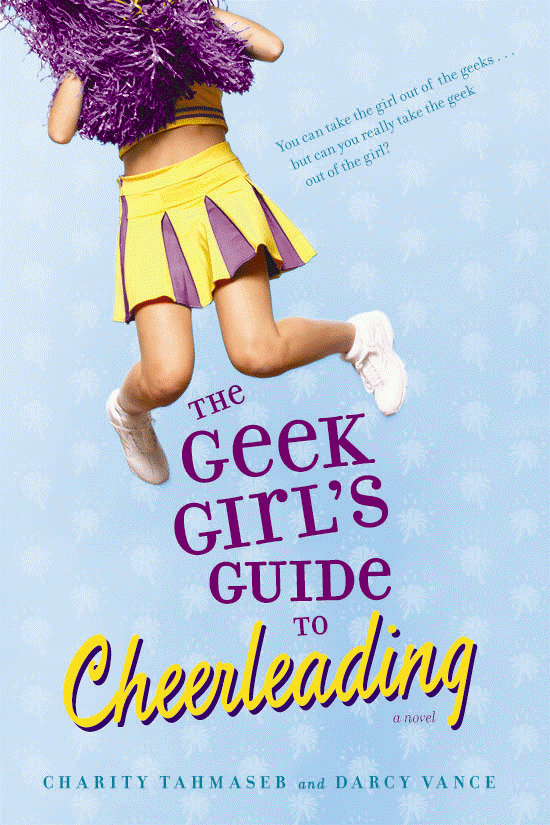
I know I’ve been scarce around here. (Ha. Look up scarce in the dictionary, and there I am.) I’m working on copy edits for The Geek Girl’s Guide to Cheerleading this weekend. Once I got over the massive amount of red on the manuscript (mostly instructions for the keyboarder), it hasn’t been all that bad.

No. Really. I mean that. Most of it is adhering to the publishing house style (I must learn to curb my comma addiction). But we do have to respond to some things, and we have been. Take this answer, for instance:

Yes to football players. The basketball players are still in the locker room.

Kind of makes you wonder what the question was.

Writing practice ~ Write on Wednesday

From Becca’s Write on Wednesday:

How about you? Do you have a writing practice? What’s it like? How has it helped you become a better writer? If you’re thinking about starting a writing practice, how do you envision it? What would work for you?

Over on the Write on Wednesday site, Becca has a great summary of what writing practice is, along with author Natalie Goldberg’s take on it.

I do writing practice or morning pages or whatever you want to call it every morning. Like Becca I really need that first cup of coffee to get going. It goes pretty much like this:

  • Start the coffee
  • Open up my notebook
  • Write down the date and a few words
  • Zone out for a bit
  • Get coffee
  • Write

After that, I work out (after three cups of coffee, I’m beyond ready to work out). Over the years, I’ve experimented with the best time for writing practice/coffee/exercise. Starting back in November 2007, I finally hit upon the combination that works (at least for now).

Back in the day, as a young lieutenant, I used to laugh at the “old” warrant officers and sergeants who’d show up at first formation with a large cup of coffee. They’d say, “Just you wait, ma’am. Just you wait.”

These days, I so need that cup (or three) in the morning–both to write and exercise. And I hereby extend an apology to Chief Warrant Officers F. and M. along with Master Sergeant D. You guys were right.

A friend of mine called morning pages/practice “the best therapy money can’t buy.” Julia Cameron recommends them for all artists, not just writers. I think, initially, it’s hard to get past not writing something of significance.

These days, I happily litter my morning pages with Internet shorthand (I seem to LOL to myself a lot) and litanies about how tired I am (generally written before that second cup).

So, writing practice. Like the swearing (see yesterday’s post), it’s something I highly recommend.

Wednesday, Friday … just write

I discovered Write on Wednesday via Anno. And yes, I know it’s Friday.

1. Do you write fiction or non-fiction?  Or both?

I work as a technical writer, so depending where we are in the development process, I’m either writing fiction or non-fiction. Trust me on that.

I also write the (very) occasional article and the sometimes short story. Oh, yeah. And the books (fiction). I guess I write those too.

2. Do you keep a journal or a writing notebook? 

Yes and yes. I have various paper notebooks and computer files. I just downloaded Inspiration so I can manage the research I’m doing for a possible historical/historical YA novel.

3. If you write fiction, do you know your characters’ goals, motivations, and conflicts before you start writing or is that something else you discover only after you start writing? Do you find books on plotting useful or harmful?

I do a lot of prep work and I like to have a “road map” for where I’m going. For novels, I also do extensive character “memoirs.” They’re not interviews, they’re not biographies/sketches, because I write the in first person. I don’t know what else to call them.

The one writing craft book I recommend without reservation (as my writing friends know) is Writing the Breakout Novel Workbook by Donald Maass.

Despite all this, I’m totally open to changing things on the fly. I once threw out 7,000 words because I realized I was going in the wrong direction.

4. Are you a procrastinator or does the itch to write keep at you until you sit down and work?

I procrastinate when something is wrong. Either I’m not approaching a scene correctly or I need some time to “walk around” a scene/topic before I tackle it. I used to freak when I did this; now I know it’s simply part of my process. Although, sometimes, I still freak. Just ask Darcy.

5. Do you write in short bursts of creative energy, or can you sit down and write for hours at a time?

Yes and yes. It depends on how much time I have.

6. Are you a morning or afternoon writer?

I can work either time, but I like to do things and mull things over in the mornings, then write in the early afternoon.

7. Do you write with music/the noise of children/in a cafe or other public setting, or do you need complete silence to concentrate?

I can write with kids/cartoons howling in the background, with one exception. That’s when I have the master manuscript on one half of the screen, Darcy’s edited version on the other half, and the markups from our editor in a document holder. Then, all bets are off.

8. Computer or longhand? (or typewriter?)

Yes and yes. Depends on my mood.

9. Do you know the ending before you type Chapter One?  Or do you let the story evolve as you write?

In general. See above where I say I have a road map. This, too, can change.

10. Does what’s selling in the market influence how and what you write?

Thing is, books coming out right now were bought anywhere from 12 to even up to 24 months ago. I do keep an eye on Publisher’s Marketplace, but then, I’m publishing news junkie, so what can I say.

And of course, the deals that come through on Publishers Marketplace are just those people feel like reporting. Still, you can glean things from there, like how next year, it will be the Summer of the Zombie in YA and so on.

11. Editing/Revision – love it or hate it?

I’m not sure how Darcy feels after our editing experience with Geek Girl’s Guide, but I still love it. I love have that second, third, twelfth chance to get it right.

Synchro and San Fran

If you ask my kids what they loved best about our San Francisco trip, they’ll both say: swimming and the beach. Seriously, I think they could have spent the entire time in the pool at my sister’s place and been completely satisfied.

True, Andrew’s a little unclear on the pointed toes concept:

This might be my favorite picture from the trip. It looks like she might end up doing a colossal belly flop, but she didn’t.

I love how she’s reaching for the sky.

Now that Geek Girl’s Guide has gone to copy edits (man, that sounds surreal), I’m back to working on The Fine Art of Holding Your Breath, AKA MacKenna’s story. In this pursuit I, of course, got sidetracked on YouTube, looking for synchronized swimming videos.

Because, you know, that’s really important for the writing. Also important, if you’re writing a book with a sport, make sure it’s one people like to mock (cheerleading, synchronized swimming, etc.).

Note to YouTube users: the video of your Cancun vacation where you’re clearly drunk and pretending to swim synchro? Not really funny. Trust me on that.

I’m hoping we get more good video from the Olympics. In the meantime, enjoy the following. Sure, they’re commercials, but they’re also pretty cool.

All I can say about the 0:39 point: Ouch.

You can see more of the “traditional” elements of synchro in this one:

I love the lift in this one.

Behold, the published author!

No, not me, but Andrew:

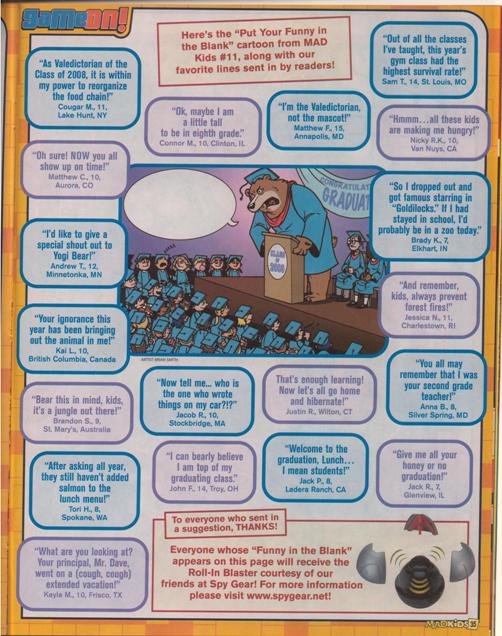
We sent his “Funny in the Blank” into MadKids back in June and it now appears in the September issue. His is the one on the left hand side just below the dialogue bubble and it says:

I’d like to give a special shout out to Yogi Bear!

(Click on the image if you want to see a larger size.)

Yes, he thought of it himself (I’m not that funny). And yes, it’s entirely possible I’m way more excited about this than he is. I haven’t made it into a magazine with that kind of national circulation. I don’t understand why no one else finds that as exciting as I do. Hey, navigating the slush pile of a national magazine is no small task.

Although I think he is more excited than he’ll let on: he wants to show his best friends this weekend. And when he brought the magazine inside, he whipped through those pages pretty quickly looking for this one.

Yeah. I’d say he’s excited too.

The Geek Girl’s Guide to Fonts


You Are Andale Mono


You are a geek, pure and simple.You spend a lot of time online.

In fact, you probably love the internet more than anyone you know.

You are picky about design, mostly for readability’s sake.

You are the type most likely to be irritated by a bad font.


This is so appropriate for a technical writer. Never witnessed a font war? Good times.

In other Geek Girl news, the manuscript is official and accepted and off to copy editing. I think Darcy is officially taking a nap. I know she deserves one. I’m officially going to watch some synchronized swimming.