New Year, new book

So, you can see my progress, or everyone’s progress over at JaNo if you’re so inclined. I won’t repeat my angstacular post about my fear of writing something new, which I haven’t done in about two years. (Oops, I guess I just did repeat. Oh. Well.)

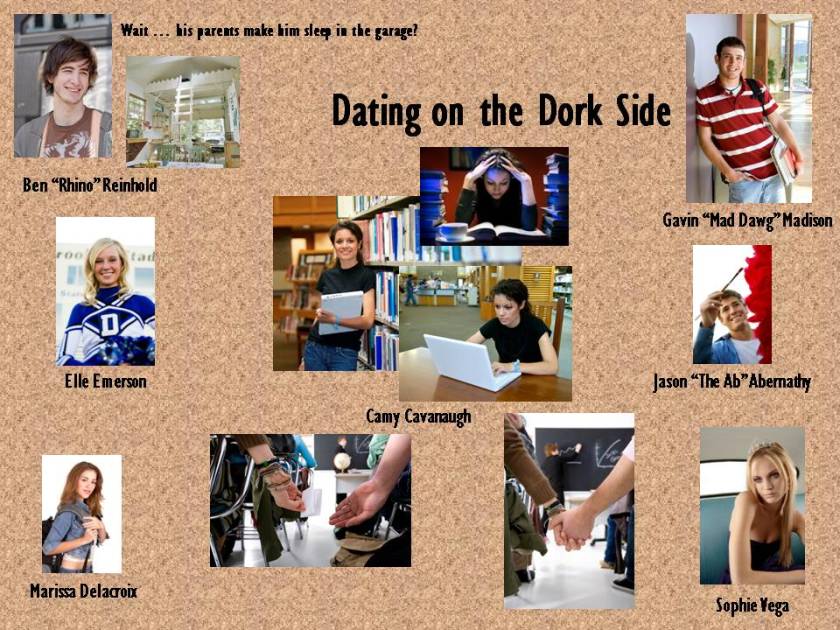
I will share my collage, cuz I’m pretty psyched about it:

dork-collage

Seriously, forget writing, I should do this for a living

I realized something though. All three boys have nicknames. We have:

  • Ben “Rhino” Reinhold
  • Gavin “Mad Dawg” Madison
  • Jason “The Ab” Abernathy

I may have to rethink that. But one cool thing, I asked Darcy if I could resurrect one of her characters. She, very rightly, combined two, but of course, one character can’t have two names (unless they happen to be boys in the book I’m writing, then apparently, it’s open season on names). So I asked if I could use “Sophie Vega,” which is a name/character I’ve always loved.

Of course, the Sophie in the collage above looks like she could cut you with both her words and her sharp, sharp tiara. Then leave to you bleed behind the school.

And I leave you with this:

True, my best friend Rhino had breached the school’s firewall. I was pretty sure that was beyond the capabilities of anyone nicknamed The Ab.


Now all I have to do is write the book

So, I was cruising around Amazon the other day, looking for YA books and other things to add to my wish list when I came across Jessica’s Guide to Dating on the Dark Side.

I have to tell you, I was totally excited. I thought, hey maybe we should contact the author about doing a little cross-promotion. Now, you’re probably wondering why I’d think that about a vampire book. Well, at first glance, I didn’t see a vampire book. I saw this:

Jessica’s Guide to Dating on the Dork Side

Sad, but true. Although I still think that would fit into the Geek Girl milieu. (Bet you didn’t know there was a Geek Girl milieu; I didn’t either until I wrote that sentence.)

So. No cross-promo op there. (Still, it sounds like a fun book and the cover is gorgeous.)

That being said, I’m mulling over Dating of the Dork Side as an idea. So, I totally have dibs on it.

But it got me thinking about funny (and long) titles for books that may or may not exist (yet). The other title I came up with was:

I Suck: Memoir of a Teenage Vampire (or How I Took a Bite out of the Varsity Football Team, Bled the Student Council Dry, and Got the Girl)

I have dibs on this on this as well. I’m totally writing it someday. After I finish that Millionaire Boss’s Amnesic Virgin’s Secret Baby book I’m planning to write.

Anyone else have a title? Extra points if you can include, in no particular order: zombies, secret babies, vampires, secret vampire babies, memory loss, memory loss involving werewolves, zombie cheerleaders, vampiric millionaire bosses.

Five questions you might ask my agent

If, you know, you were curious about her move from one agency to another. They were curious over at the Guide to Literary Agents editor’s blog:

Five Questions

Go on and have a read. I’ll be here when you get back. Well, actually, I probably won’t be; I’ll be eating my peanut butter and raspberry preserves sandwich for lunch. But you know what I mean.

Cold

Not really the weather, since it’s a balmy 31 degrees according to my weather widget–and sunny. But me, and Miss B. We. Have. Colds. Or coughs. (Or cough-es, as she used to say, because that’s more than one cough.)

I’m wearing a long-sleeved T-shirt, plus I have my old school, velour-lined hoodie on the back of my writing chair–just in case.

However, the house is filled with restorative things:

  • The Republic of Tea’s Kiwi Pear Green Tea–with honey.
  • Pecan pie (recipe here–so good).
  • Pumpkin pie (you wouldn’t want to neglect a pie–it might hurt its feelings)
  • Being on page 321 of 343 of the edit for The Fine Art of Holding Your Breath
  • Having a good excuse to hibernate and finish it.

Getting schooled: a writer prepares (for the worst)

Despite all his talk about writing from the unconscious, Butler believes a writer should prepare before sitting down to write a novel.

So, does he want you to outline?

Nooooooo.

Brainstorm, do character sheets?

Nooooooo.

Plot boards, Excel spreadsheets, synopses?

Nooooooo.

He wants you to dreamstorm your novel. Yes. You’ve heard it here first. (Well, unless you’ve read Butler’s book, in which case, you heard it there first.)

It goes something like this:

  • Dreamstorm a scene from something sensual, by making a list of words, having some sort of sense impression attached to it with the briefest identifier of that scene. Do this for a whole bunch of scenes. It doesn’t matter at this point if two scenes contradict each other.
  • After eight to twelve weeks (yes, really), Butler suggests the next stage is to write a phrase identifying the scene on a 3 X 5 card.
  • Then orchestrate the scenes, embracing the randomness in creating the sequence, but looking for continuity. (No, I don’t know what this means.)
  • Look for the first good scene, the best point of attack, to begin the flow of sensual moments. (This, however, makes more sense.)

Butler believes in the natural sequence. (I don’t know if this is like natural selection or not.)

Actually, what he means is the scenes will eventually fall into an order that works for the story. You start with the best point of attack, Then select a few more follow-up scenes to write. after you write those scenes, you look at the remaining ones. You may need to rearrange or dreamstorm new scenes based on what you’ve written.

He doesn’t like the idea of writing out of order. If you start writing a scene without any previous context, he believes you’ll lose the unconscious aspect of it. You end up creating ideas as to why the scene is happening rather than dreamstorming them.

At some point you type: The End.

In all seriousness, I am all over the index card idea. You can do anything with index cards. Miss B can create a whole cityscape with inhabitants and pets with index cards. The very least I can do is write a novel.

Getting Schooled: If we were a movie

Now here’s a chapter I think we can all get behind. Butler calls it cinema of the mind. He’s not talking adaptations here, but rather film techniques writers can use. These are:

  • The shot: A unit of uninterrupted flow of imagery.
  • The cut: A transitional device for getting from one shot to another.
  • Dissolve: A transitional device that superimposes a second image over the first as it fades out.
  • Scenes: Unified actions occurring in a single time and place; a group comprises a sequence.

Butler considers the montage the most crucial element (that’s why it gets its own paragraph). This is where you put two things next to each other, causing a third to emerge.

For instance, we see pie tin with a bit of lone crust, a smear of chocolate filling, a bit of whipped cream. On the floor, two children (perhaps a big brother and his little sister), mouths rimmed with chocolate, whipped cream on noses and cheeks, the two snoozing lightly.

Yeah, we pretty much know what went on.

And that’s pretty much it. I know. Butler, this easy? Okay, so in the text, he goes into detailed (but helpful) examples from Hemingway and Dickens. But the advice is to write the movie in your mind.

Getting Schooled: The unbearable lightness of yearning

Ha. You thought I forgot. But, I. Did. Not. Butler is back and he’s feisty as ever. Today’s topic is yearning. Or, in Butler’s words:

I would say that of the three fundamentals of fiction, there are two that aspiring writers never miss: first, that fiction is about human beings; second, that it’s about human emotion. Even when fiction writers are writing from their heads, abstracting and analyzing, they’re mostly analyzing emotions; so even if they’re not getting at the essence of emotion, they’re trying to.

But the third element, which is missing from virtually every student manuscript I’ve seen, has to do with the phenomenon of desire.

By which he doesn’t mean romantic desire (although I suppose it could).

Yearning is always part of the fictional character. In fact, one way to understand plot is that it represents the dynamics of desire.

He goes on to state that you can have a story rich in character, conflict, problems, attitude and so on, and totally miss the desire boat. And if that ship sails without you, you pretty much don’t have a story.

This is also the chapter with what I call the Great Genre Dis. Butler draws a firm line between writing that is art and … all the rest, what he calls “entertainment writing.”

Nice.

His main argument is essentially that this type of writing uses generalizations and abstractions and that what readers do is fill in the blanks left by those abstractions.

I’m neither here nor there with this argument, although I know it upsets some writers greatly. There’s some great genre fiction out there and some pretty crappy literary fiction. I also find some “entertainment fiction” far from entertaining and some literary fiction utterly absorbing.

I don’t know art, but I know what I like? What else can you say?

Still, Butler does give genre writers their props, since they almost always “get” the idea that their character yearns for something–to solve the mystery, save the world, get the girl. (Dude, that sounds like a great story. I’m so writing that.)

So, genre wars aside, yearning is a concept that you can apply to any type of writing. I decree it so.

Speaking of yearning, I’m sure you’re dying to know how I’ve done on my quizzes so far:

Quiz 1: 13/15 for a B

Quiz 2: 8/8 for an A

Getting Schooled: Review

So today I thought we’d review what we’ve learned so far thanks to Robert Olen Butler. But instead of actually writing something, I thought I’d let the Internet do it for me.

Just think of how close we are to the day where we won’t have to write our own blog posts!

Let’s review:

words

Summary brought to you by Wordle.