Why ideas aren’t the same as books

On February 6th, I wrote the following as my Facebook status:

Last night’s dream: I was selected to write a modern retelling of Chitty Chitty Bang Bang. And that’s just what the world needs right now.

From today’s Publishers Marketplace:

Frank Cottrell Boyce’s CHITTY CHITTY BANG BANG FLIES AGAIN, with black and white illustrations by illustrator and animator Joe Berger, featuring the Tooting family, who discover an old race-car engine and fit it to their VW Samba Bus; soon they are hurtling across the world rebuilding the original Chitty – with a sinister character on their tail, based on the original by Ian Fleming, to Hilary Van Dusen at Candlewick Press, in a six-figure deal, at auction, in a three-book deal, for publication in Spring 2012, by Zoe Pagnamenta of the Zoe Pagnamenta Agency on behalf of Simon Trewin at United Agents.

Apparently, it is what the world needs right now, to the tune of six figures, no less. So. Yeah. It kinds of leaves you wondering. Where’s my six-figure deal?

Not in Chitty Chitty Bang Bang’s trunk, that’s for sure.

Here’s the thing: I do this all the time. I once wondered if anyone bothered to write a retelling of Anna Karenina. Why did I wonder this? I don’t know.

A week later, a deal came through on Publishers Marketplace for … wait for it … a retelling of Anna Karenina.

That novel about a modern US civil war? Yep, had that idea–twice (two different versions). Same for a bunch of others that I’m too depressed to enumerate here.

I’m either really tied into the collective unconscious or I should start writing these things down.

That’s the key. Everybody has ideas; writing 50,000 – 100,000 words in a row so they make sense is what separates the idea from a book. And honestly, I never wanted to write a retelling of Anna Karenina, or Chitty Chitty Bang Bang, for that matter, not even to the tune of six-figures.

Still. It kind of leaves you wondering.

When people used to carry rotary phones in their pockets

So, the other day I was flipping through an old manuscript (and by flipping, I mean electronically and by old, I mean, the first one), when I noticed an odd sort of quirk.

Every time (and I do mean every time) I mention a cell phone in the narrative, I made sure to spell it out, as in: cellular phone. Okay, once or twice I used mobile phone.

But. Yeah. I don’t know if I received some sort of feedback (and this would be about ten years ago) that indicated people might be confused if I didn’t spell out cellular phone, but there it is. Every. Single. Time. Apparently my aim was clarity.

The quirk is so very obvious, at least to my eye and after all these years. It’s funny how a manuscript can age in ways you don’t expect. Of course, today, I could write: He pulled the phone from his pocket and started texting his best friend.

Is that a princess phone in your pocket or are you just happy to see me.


And no one is confused or imagining that he carries a rotary phone in his pocket. But back in the day?

Apparently a few of us were very confused about phones.

What I did this weekend

Cover of "Deep Down Popular"
Cover of Deep Down Popular

What I did, the weekend edition:

  1. Took two karate classes
  2. Baked banana bread
  3. Did the laundry
  4. Finished reading a novel (Deep Down Popular by Phoebe Stone)
  5. Finished writing a novel

Yes, the first draft of what I’m calling Speechless (even though I wrote a short story with the same title–actually, the short story inspired the novel) is done.

This is less impressive when you learn that the word count is only 32,000. I did that on purpose. This is an upper middle grade/tween novel and that length gives me plenty of room for revisions. I can comfortably add 10,000 words and not freak the freak out about word count.

And of course, during all this, the kids were messing around with Andrew’s video camera on the back deck. They set it up on a tripod so it was pointed right at me (we have a series of glass doors/windows that face the backyard). Then they would knock on the door and run away (but, thanks to all that glass, I could see them–so yeah, not very subtle). Once, I stepped out on the deck and said something to the camera about trying to write.

Later, they holed up in a bedroom to watch their masterpiece with much giggling.

So, if you’re imaging me in some idyllic writer’s paradise … um, yeah, not so much. It’s me, the cooling banana bread, the dog wanting to go outside, and the kids turning me into their own reality show.

Secret project revealed!

Pretty excited about this! Here’s the press release for the 2009 Debutantes e-anthology:

New York Times bestselling author Jessica Verday announces an e-anthology featuring 25 authors from the writers group 2009 Debutantes

The bestselling author of THE HOLLOW Trilogy, Jessica Verday, has gathered 24 other authors for a kind of Young Adult sampler featuring a theme of “Firsts.” The eBook will be published by Verday herself and she will be co-editing with Rhonda Stapleton author of the STUPID CUPID series.

This eBook will give readers a chance to sample the stories of 25 different authors exploring what it’s like to experience something for the first time. From first kiss to first love, there’s no time like the first time.

“This is an innovative way for authors to reach out to readers in a single book that anyone can afford. Readers get the chance to find a new story from some of their favorite authors, and while they’re at it, be introduced to other authors they may not have been able to get to know yet,” says Verday.

The e-anthology will be available on Amazon Kindle and Smashwords. The tentative release date is October 4, 2011.

Contributing authors are: Jessica Verday, Carrie Ryan, Rhonda Stapleton, Cyn Balog, Lauren Bjorkman, Leigh Brescia, Teri Hall, Stacey Jay, C. Lee McKenzie, Janet Gurtler, Jenny Moss, Jackson Pearce, Kristina Springer, Charity Tahmaseb, Jon Skovron, Heidi Kling, Saundra Mitchell, Cheryl Renee Herbsman, Kirstin Cronn-Mills, Lara Zielin, Shani Petroff, Kurtis Scaletta, J.A. Yang, Jennifer Brown, and Sydney Salter.

Cover to be revealed May 2011.

You can read a bit more over at Jessica’s blog.

You know what this means, of course. I am writing under contract. So, I guess I better get busy and do just that.

More updates to come, I’m sure.

WWW Wednesday: the post-Rita edition

It’s WWW Wednesday!

To play along, just answer the following three (3) questions…

  • What are you currently reading?
  • What did you recently finish reading?
  • What do you think you’ll read next?

On Monday evening, I entered the last score for the Rita books I’ve been reading and heaved a sigh of relief. Not that reading for the contest is a bad thing. It’s the pressure, the list of books waiting for their score. They look so sad, sitting there, scoreless. But no more!

So, now, back to talking about books!

Currently reading:

On the nightstand: The Vespertine by Saundra Mitchell ~ the new release from the wonderfully talented Saundra, one of the 2009 Debs.

In the car: Matched by Ally Condie ~ this is a great book–and audio book–so far. Really enjoying my commute this week.

 Just finished reading:

Unbroken: A World War II Story of Survival, Resilience, and Redemption by Laura Hillenbrand

The Anatomy of Story: 22 Steps to Becoming a Master Storyteller by John Truby ~ Wow, this one was … intense, but I got a lot out of it.

Reading next:

For the nightstand: Rival by Sara Bennett Wealer ~ Sara’s debut and I can’t wait to read it.

For the car: The Girl Who Played with Fire by StiegLarsson ~ the first one was a great commute read, minus scratches on the CDs. I have high hopes for this one.

Peeking out …

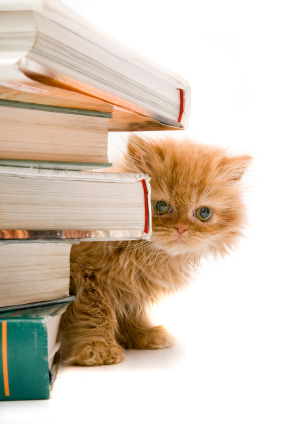
Peeking out from behind my stack of Rita Award books*. Just one more to go! So … clearly I’ve been reading. And I’ve been writing, too. I just haven’t been writing in my blog (again, clearly).

So what better way to illustrate that than posting a  picture of a kitten and some books! Who doesn’t love kittens? Or books? Plus, Googling “stack of books” + kitten is like gold. Ah, internets, I love you.

I hope to return to a more reliable (oh, who am I kidding, I won’t be that reliable) or more frequent, at least, blogging schedule soon.

Until then, I have books to read.

*Books pictured do not resemble actual Rita books. Any similarity is purely coincidental.

Bad Writing

Courtesy of Ta-Nehisi Coates comes this gem:

Bad Writing is a documentary about a wannabe poet who sets off on a quest for answers about bad writing, good writing, and the process in between. What he learns from some leading figures in the literary world will inspire anyone who has ever dreamt of creating art. Featuring interviews with David Sedaris, Margaret Atwood, George Saunders, Steve Almond and Nick Flynn.

And as Ta-Nehisis Coates writes:

The ability to go to war with one’s own awfulness requires a special kind of moxie. I believe that many people have the talent to write. But very few have the courage to rewrite. Even fewer have the courage to rewrite fail, and live to do the whole thing again. And even this gets it wrong. It makes it sound like all of this is some sort of choice.

This topic fascinates me. I so want to see this documentary. I did a lot of reading on talent last year: Outliers, The Talent Code, Talent is Overrated. Seriously, if it had “talent” in the title, I was there. I also reflected on my on rate of failure (epic), in particular, during the last year. I have some definite opinions on writing, talent, success, failure and all the rest. If I can get them into coherent form, I’ll post them here.

The DVD is available from IndieFlix.

BTT: Is this the real life

From Booking Through Thursday this week:

I am paraphrasing from a friend’s Facebook wall her question:
“How would a teen-age boy who is going to work with his hands ever use Literature of England in his work?”
The age-old “How am I going to use this in real life?” question. How would you answer it?

Participants this week are writing some wonderful answers. For the sake of time, I’m going steal mine. From one of the writing craft books I’m working through (yes, it’s true, the answer to the question about reading is in … a book):

From The Anatomy of Story by John Truby:

Stories don’t show the audience* the “real world”; they show the story world. The story world isn’t a copy of life as it is. It’s life as human beings imagine it could be. It is human life condensed and heightened so that the audience can gain a better understanding of how life itself works.

*Note: The book is billed as a screenwriting book (hence the use of audience), but it applies to all types of stories.

Books, literature, stories teach us empathy. What’s that old saying? You never really know someone until you’ve walked a mile in his shoes. Literature lets us do that. Never mind cultural literacy, I believe reading can make us better people.

Plus, having a passing familiarity with the Western Canon means you don’t have to have people explain song lyrics to you.

L. K. Madigan’s feast of awesome giveaway

The 2009 Debs are celebrating L.K. Madigan’s wonderful books to support her fight against cancer. This past week Lisa shared her very difficult news on her blog.

To show our love and support for her, we’re giving away 40 sets of her two novels over on the 2009 Debs website. Each winner will receive both Flash Burnout and The Mermaid’s Mirror. To enter, simply help spread the love.

Lisa’s first novel, FLASH BURNOUT, won the Morris Award in 2009. Her second novel, THE MERMAID’S MIRROR received a starred review from Booklist.

The contest runs through Monday, January 31st. Click through to the 2009 Debs website for all the information.

Of typos and doe’s snot

The other day, this landed in my inbox:

Win Cash and Prizes with you best writing!

The best part? It came from Writer’s Digest.

I really think the fine folks at Writer’s Digest should use this to their advantage with a funny, follow-up email about how a typo isn’t the end of the world (or even your chances in a contest), but that proofreading can help.

Still, my personal best for typos is the time I wrote:

It’s doe’s snot.

I wrote this particular phrase in a software installation manual. Our software does many things, but it doesn’t need doe’s snot to do them.

The best part? A straight-faced software engineer placed the marked up hardcopy guide on my desk without a word.

So while I don’t want to read novels riddled with typographical errors, I try to keep perspective (especially for blog posts and email).

Typos, like doe’s snot, sometimes happen.